

The most dangerous thing about a failing roadmap is that it looks exactly right in the review.
The themes are strategic. Leadership is aligned. The dates feel ambitious but achievable. Three weeks later, you're having a completely different conversation — about why Q2 commitments have shifted, why the customer feedback from last month still hasn't influenced anything, why engineering is executing against a backlog that has only a loose relationship with what was on that slide.
Most organizations reach for a prioritization fix. Better scoring models. More stakeholder alignment sessions. A more disciplined quarterly planning process. These are the right answers to the wrong question.
"The roadmap isn't breaking because you're prioritizing badly. It's breaking because it's a document. And documents don't survive contact with reality."
A document disconnected from strategy is just a feature list with dates
There are three structural disconnects that turn roadmaps into fiction. They operate quietly, they compound each other, and no prioritization framework fixes any of them.
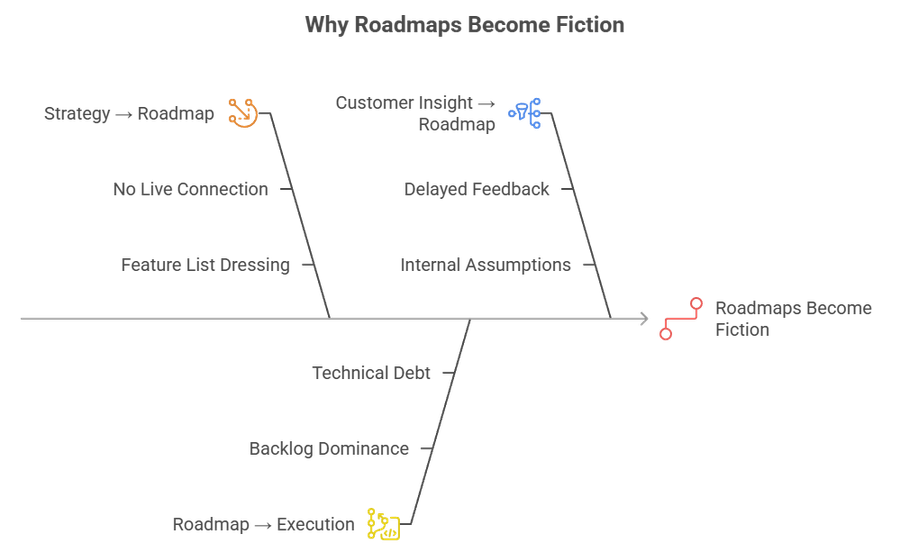
Disconnect 1: Strategy → Roadmap
Business objectives and OKRs sit in one place — a quarterly offsite deck, a company wiki, a leadership slide from January. The roadmap sits somewhere else. No live connection exists between the two, so the roadmap gradually becomes a feature list dressed in strategic language. Items survive planning cycles not because they serve an objective but because someone important asked for them.
Disconnect 2: Roadmap → Execution
The roadmap says "launch Feature X in Q2." The backlog has forty items, three active sprints, and a growing weight of technical debt. Teams execute against the backlog because that's where the real work lives. The roadmap, separated from that reality, documents intentions while the team ships something adjacent to them.
Disconnect 3: Customer Insight → Roadmap
Feedback lives in support tickets, in Intercom conversations, in sales call notes, in NPS scores that get averaged into a number and presented at a quarterly review. By the time any of it touches a prioritization decision, it has been delayed, filtered, and reinterpreted by whoever was in the room. The roadmap reflects internal assumptions more than customer reality.
These three disconnects don't operate independently. They stack. A team can be shipping consistently, running weekly reviews, scoring features against a framework — and still building the wrong things, because the architecture underneath is broken.
The cost that accumulates when teams skip or compress discovery — building without evidence, planning without customer reality. It compounds with every roadmap cycle that doesn't address the structural gap. Most teams mistake it for an execution problem. It isn't.
High-performing teams don't plan better. They operate with a different architecture.
The teams that consistently deliver business outcomes aren't smarter or better resourced. They've solved the structural problem at the source rather than working around it.
They make outcomes the unit of planning, not features.
Before anything goes on the roadmap, there's a specific, measurable objective attached to it. Features become the expression of an objective — not the objective itself. This sounds obvious. It is almost never actually practiced, because it requires a live connection between the roadmap and the strategic framework, not a once-a-quarter alignment check.
They build a continuous Evidence Stack.
Not a research phase that precedes planning — an ongoing flow of customer insight that feeds directly into prioritization decisions. Every item on the roadmap traces back to a customer problem or a validated opportunity. Not a stakeholder's preference. Not an assumption from six months ago. Evidence, with a timestamp.
They maintain portfolio visibility.
In organizations with multiple products or teams, the most common failure mode is local optimization — each team producing a well-considered roadmap in isolation, with no one seeing the full picture.
The best organizations hold a portfolio-level view where leadership can see which strategic themes are well-resourced, which are thin, and whether the organization is pulling in the same direction. This isn't a reporting exercise. It's a strategic alignment tool.
They use intervals, not hard dates.
Fixed-date roadmaps create false certainty and constant firefighting the moment reality changes. Interval-based planning — organized around flexible cycles that match how the organization actually works — gives teams the structure of a timeline without the brittleness. Plan with confidence. Adapt without drama.
None of these are new ideas in isolation. What's been missing is a system that operationalizes them — where the roadmap isn't a document you maintain separately but a live view of the entire strategy-to-execution pipeline.
Think of the roadmap as a living system, not just a document. It connects strategy, execution, and customer insights into a cohesive whole.
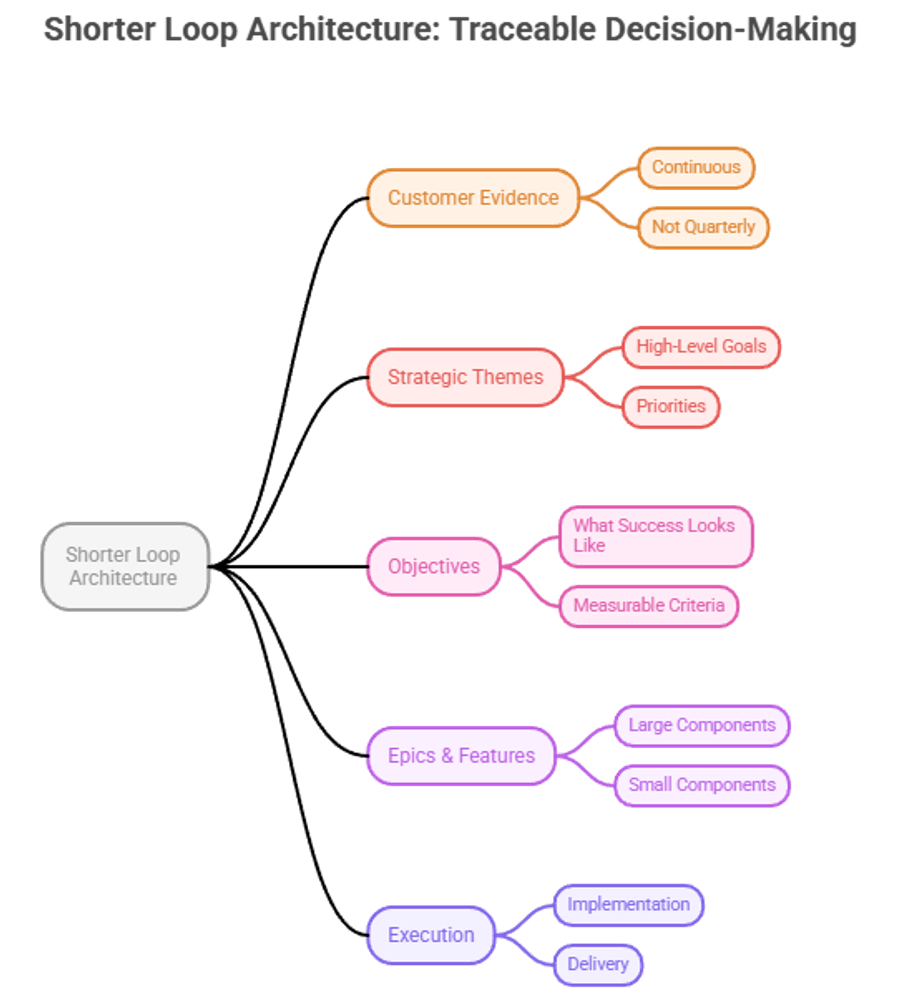
When the three disconnects are solved, the roadmap stops looking like a slide and starts functioning like a system. Strategic themes sit at the top. Objectives define what success looks like beneath each theme. Epics and features represent the actual work. And feeding into all of it — continuously, not quarterly — is the customer evidence that makes every decision traceable and every priority defensible.
This is what closes the gap between what leadership approved, what teams are building, and what customers actually need. Not a better template. Not another planning meeting. A shared system where every level of the organization sees their work in the context of the outcomes it's meant to drive.
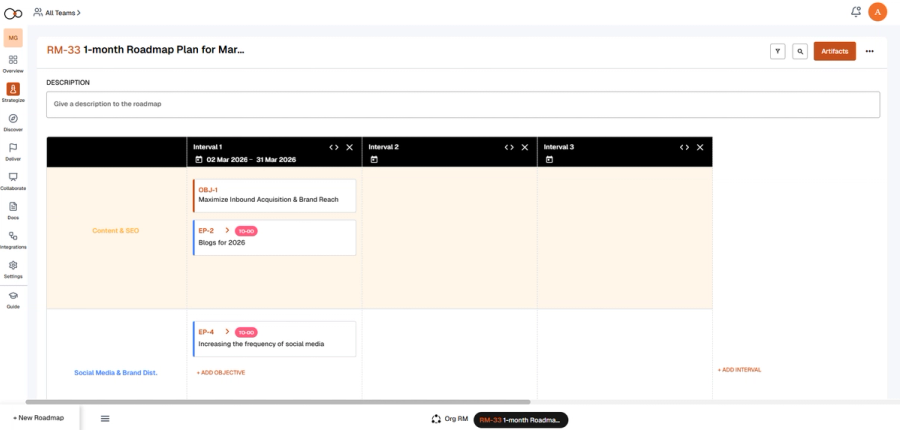
Shorter Loop's Org Roadmap is built on this architecture. It's interval-based and theme-driven, with Objectives, Epics, and Features visible across multiple products and teams in a single portfolio view — each item connected to the strategic theme that justifies it, and each theme connected to the customer evidence that informed it. The result is a roadmap that a CPO and an engineer can both find useful at the same time, just at different zoom levels.
That's the test worth applying to your current roadmap.
If you can't answer these five questions, the structure is broken
These aren't a checklist for a healthy process. They're diagnostic questions for a structural problem. If any of these produce a hesitation, that's where the disconnect lives.
1. Can every item on your roadmap be traced to a specific business objective — not implied, not assumed, but explicitly connected?
If the answer is "mostly," the strategic link isn't strong enough to survive the next quarter.
2. Does your roadmap reflect customer evidence from the last thirty days?
If updating it requires a separate research cycle, the feedback loop is too slow to be useful. You're making decisions on last season's information.
3. Can your CEO and your engineers both look at the same roadmap and find it genuinely useful?
If not, you don't have a prioritization problem. You have a visibility problem.
4. Does your roadmap live inside the same system where your team does their actual work?
If it exists in a separate tool or a slide deck, it will always lag behind reality — because reality is moving in the system your team actually uses.
5. When strategy changes, how quickly does your roadmap reflect it?
If the answer is weeks, your roadmap is documenting the past. It isn't navigating the future.
The 30% isn't a mystery
Nearly 70% of product initiatives fail to meet their intended business outcomes. That figure gets cited as a problem of execution, of prioritization, of team capability. It's none of those things. It's a structural problem that the other 30% have quietly solved.
They don't treat the roadmap as a deliverable to be produced and reviewed. They treat it as a system to be maintained — one that holds the connection between customer reality, strategic intent, and execution in a single, live view.
The teams whose customers feel the strategy in the product aren't the ones who planned best at the start of the quarter. They're the ones whose system kept the plan honest all the way through it.
