Sprint reviews stand in for customer feedback
Stakeholders see progress every two weeks. Customers see nothing for months, so the team keeps building on its first guess.
Backlog and prioritization
Once a team has chosen a solution, the next decision is how to deliver it. Shorter Loop lets you split each solution into versions such as Pilot, Prove, Expand and Mature, then put versions from different solutions together into releases.
Each release carries its own plan, runbook and communication plan. Each version stays linked to the solution, opportunity and objective it serves.
This page uses an anonymized customer example. The backlog scores, assumptions and decisions can be inspected in the demo.
A prioritization score is only as reliable as the assumptions used to create it.
The problem
Almost every software team plans in two-week sprints. Sprints make the engineering work iterative. Delivery to customers usually stays a single event: finished stories pile up until the whole solution is ready, and the first real customer feedback arrives after the last feature ships.
Delivery tools reinforce this. In Jira, a version is defined as a set of features released together, so it ends up as a date bucket for whatever is ready. Nothing in it describes what the smallest useful slice of a solution is, or what should come next.
Two separate decisions
A version is a decision about scope. It answers what the smallest useful slice of one solution is and what the next version is meant to learn or add. A release is a decision about timing and coordination. It answers which versions, from which solutions, go to customers together, and how.
When one field holds both decisions, scope follows the calendar. Whatever is finished by the release date ships, and the question of what customers needed first never gets asked.
What the research says
Large software projects overrun, and a meaningful share overrun catastrophically. The risk grows with every month a project runs before anyone checks it. An epic shipped in one piece follows the same pattern at a smaller scale. The cheapest check is to ship a small part of the solution and watch what customers do.
What it costs the team
In our experience, the cost of big-batch delivery shows up long before the budget review.
Stakeholders see progress every two weeks. Customers see nothing for months, so the team keeps building on its first guess.
Engineers complete parts that customers could use today, then hold them until the rest of the solution is done.
Support, sales and marketing learn the details late. A problem in one part can hold back the whole release.
Parts that would have been dropped after an early version stay in the product, and engineering maintains them.
A better way to deliver
Keep your sprints. Add the part sprints leave out: small releases that put each slice of a solution in customers' hands, so the next sprint can use what they did with it.
01
Use a story map, or another way of slicing, to decide what the Pilot must include, what the Prove version needs to test, what belongs in Expand, and what a Mature version would need.
02
Only the epics and features in the Pilot go to engineering first.
03
Group the versions that are ready, across solutions, into one release with a plan.
04
See what customers do with the version before committing to the next one.
05
Move features between versions, drop them, or add new ones based on what you learned.
How Shorter Loop does it
Each solution in Shorter Loop has its own backlog of epics and features. You split that backlog into versions. Separately, you build releases by picking versions from any number of solutions.
Lay out a solution's features along the customer's journey, then draw lines across the map to cut versions. A story map won't suit every backlog, but it gives most teams a clear first slice.
Move each epic and feature into a version: MVP, MVP+1, delightful, or names your team chooses.
Work on versions of several solutions at the same time. Each one keeps its own sequence.
A release can hold version 1 of one solution and version 3.5 of another. Changing a release date doesn't change what's in a version.
Each release carries the plan for getting it out, the runbook for the day, and what you'll tell customers and the rest of the company.
Every version stays connected to its solution, the opportunity it addresses and the objective above that.
Shorter Loop does not replace Jira or your sprint tool. Day-to-day delivery status comes from the tracker through the integration, so it stays current only while that integration is connected.
| Solution | Pilot | Prove | Expand | Mature |
|---|---|---|---|---|
| Solution A | In release 1 | Planned | Later | Later |
| Solution B | Shipped | In release 1 | Planned | Later |
| Solution C | In progress | Planned | Later | Later |
Release 1 takes the Pilot of solution A and Prove version of solution B. Solution C's Pilot isn't ready, so it waits for a later release without holding the others back.
Customer story Solveo · two versions of one solution
In the Strategize example, Solveo picked its solution: let the AI auto-send answers based on how complex a ticket is. The team split that solution into versions and shipped the first one to twelve pilot accounts. Every step below happened in Shorter Loop.
| Company | Solution | Pilot accounts | Releases so far |
| B2B customer-support platform | Auto-send by complexity | 12 | 2 |
STEP 01
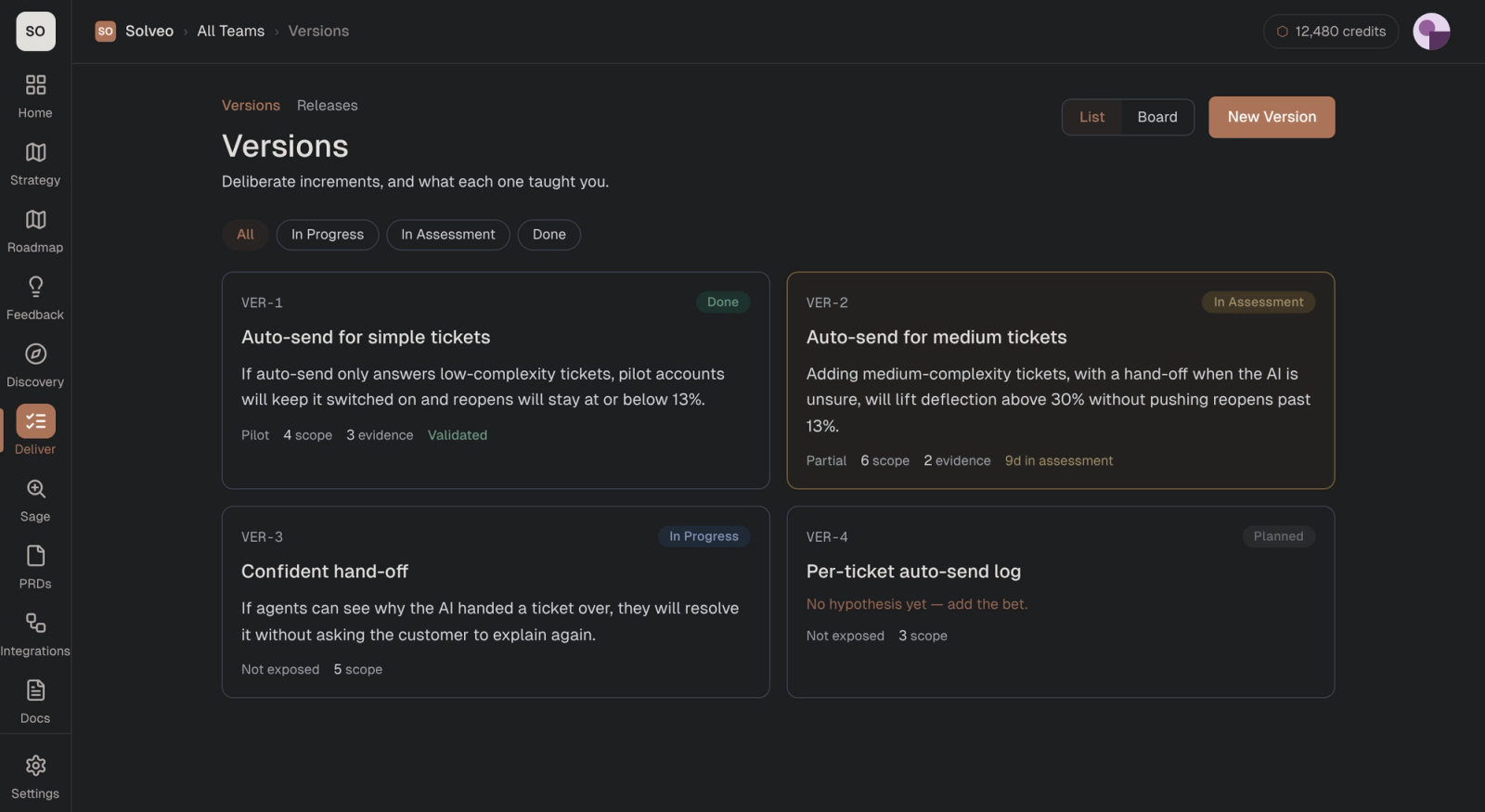
The team cut the solution into four versions and wrote down what each one had to prove before anyone started building. The fourth still has no hypothesis, and Shorter Loop says so on the card.
STEP 02
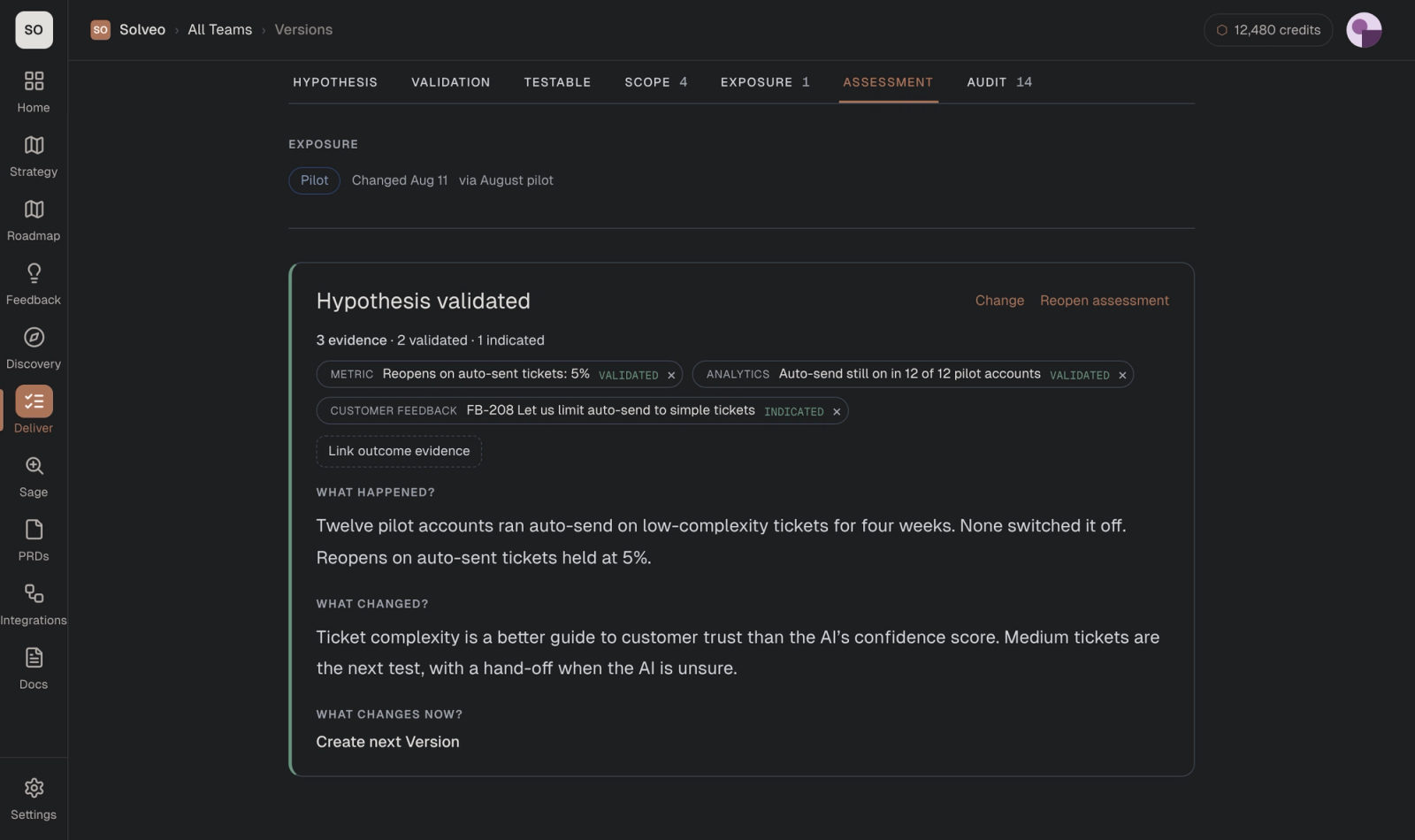
VER-1 limited auto-send to low-complexity tickets and went to twelve pilot accounts. Four weeks later the team recorded the verdict, the evidence behind it, what they learned, and the next decision: create the next version.
The evidence sits on the version itself, so anyone can see later why the team moved on.
STEP 03
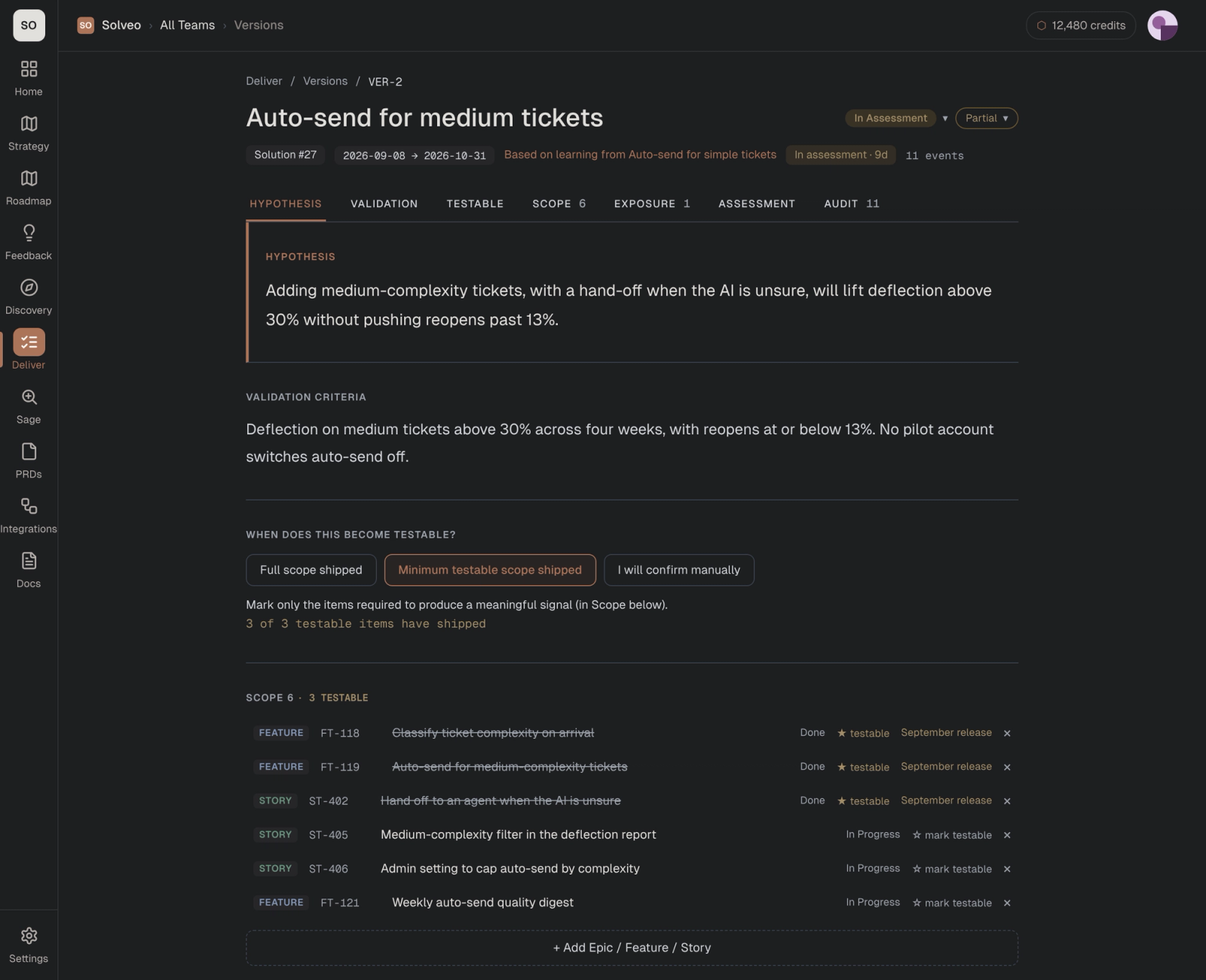
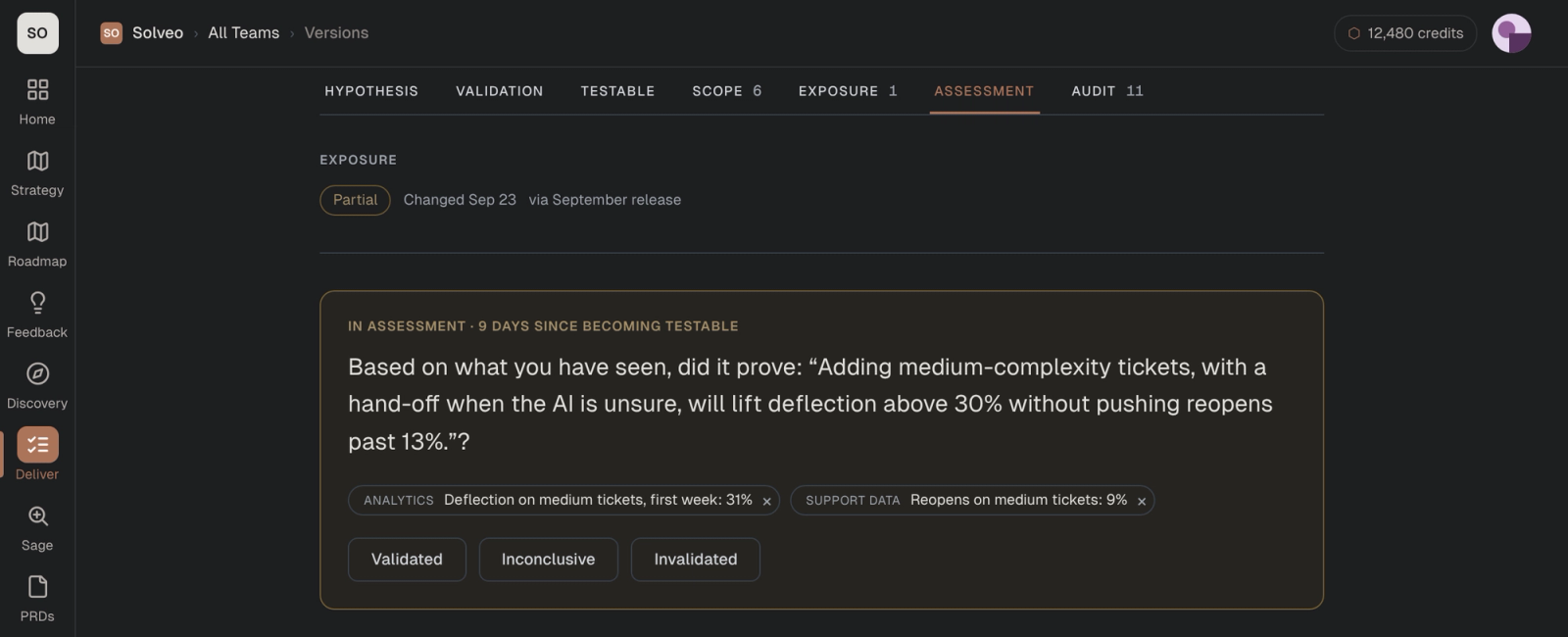
VER-2 links back to VER-1 and states its own bet: medium-complexity tickets, with a hand-off to an agent when the AI is unsure.
The team marked the three items needed for a meaningful signal. Assessment could start as soon as those shipped, while the reporting work carried on.
STEP 04
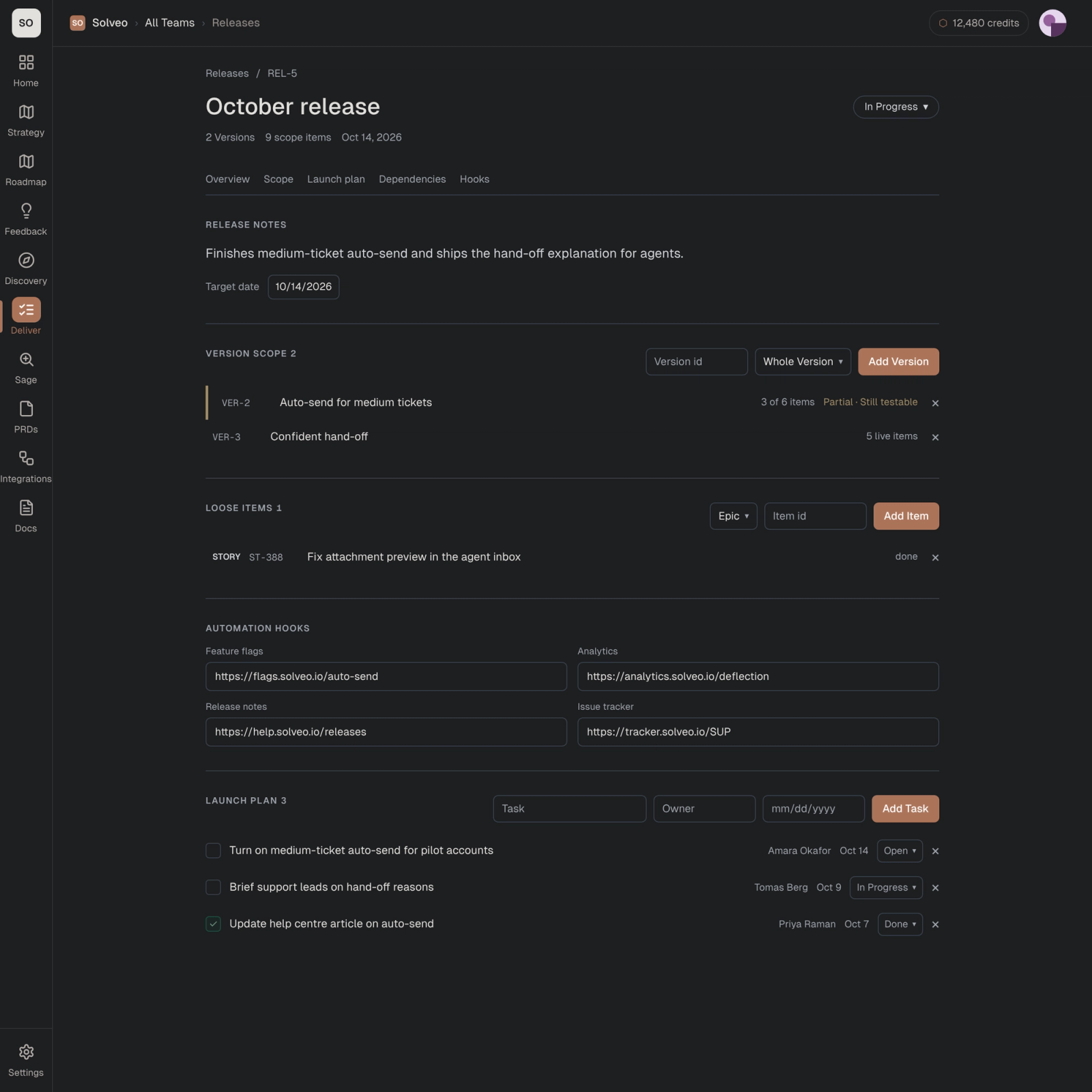
The September release carried VER-2's three testable items. The October release finishes VER-2 and adds the first version of a second solution: showing agents why the AI handed a ticket over.
Tickets and sprint status stay in the team's tracker. The release holds the versions, the launch plan and the links out to flags, analytics and the tracker.
STEP 05
Nine days after VER-2 became testable, the version asks its own hypothesis back as a question, with the first week's evidence attached. The verdict is the team's call.
Before delivery
A backlog mixes different kinds of judgment. One item may look attractive because its expected value is high. Another may be cheap to build. A third may matter because delaying it creates risk.
Shorter Loop keeps value and effort separate instead of hiding both inside one priority number. The score does not make the decision for the team. It makes the reasoning easier to question: why do we expect this much value, how much effort are we committing, and what assumptions sit underneath those estimates?
Make capacity explicit
Plotting candidate work by value and effort helps the team compare items using the same criteria. A visible cutline then records what the team intends to fund with the capacity available for the period. Work below the line stays visible, along with the reasoning, so it can be revisited when capacity or evidence changes.
The highest-ranked items still need scrutiny. A scoring model can rank its inputs correctly while an important input rests on an unsupported assumption. Before the team commits the work, Shorter Loop keeps that assumption connected to the item so the team can check whether the expected value has enough support.
Then break it down
Once an item has enough support to move forward, the team can break it into features and stories. Shorter Loop keeps the objective, evidence and decision linked to that delivery work while day-to-day status stays in the engineering tracker.
From there, the team decides how to slice the solution into Pilot, Prove, Expand and Mature versions, then combines ready versions into releases.
No. Tickets, sprints and day-to-day status stay in your tracker. Shorter Loop holds the versions, the bet each one carries, the releases and the outcomes. Status comes in through the integration.
It's optional. A version without one shows a reminder on its card, because after release there is nothing to check it against. Sage can draft one from the solution or the opportunity behind it.
You choose per version: when the full scope ships, when the items you marked as minimum testable ship, or when you confirm it yourself. Shorter Loop counts the days from then and flags versions that have gone too long without an outcome.
Yes. Add a version whole or pick specific items. A partial release is marked either still testable or a deployment step only, so a half-shipped version doesn't start its assessment too early.
Mark it inconclusive and say what you saw. The next decision can be to investigate, continue the rollout, create the next version, stop the solution, or go back to the opportunity.
It depends on how fast you can connect what you already have. For a ten-person team that has typically taken about five days.
Write down what the first version has to prove, ship it to a few customers, and record what happened before you build the next one.
This page uses an anonymized customer example. You can open the demo to inspect the versions, release and outcomes shown here.