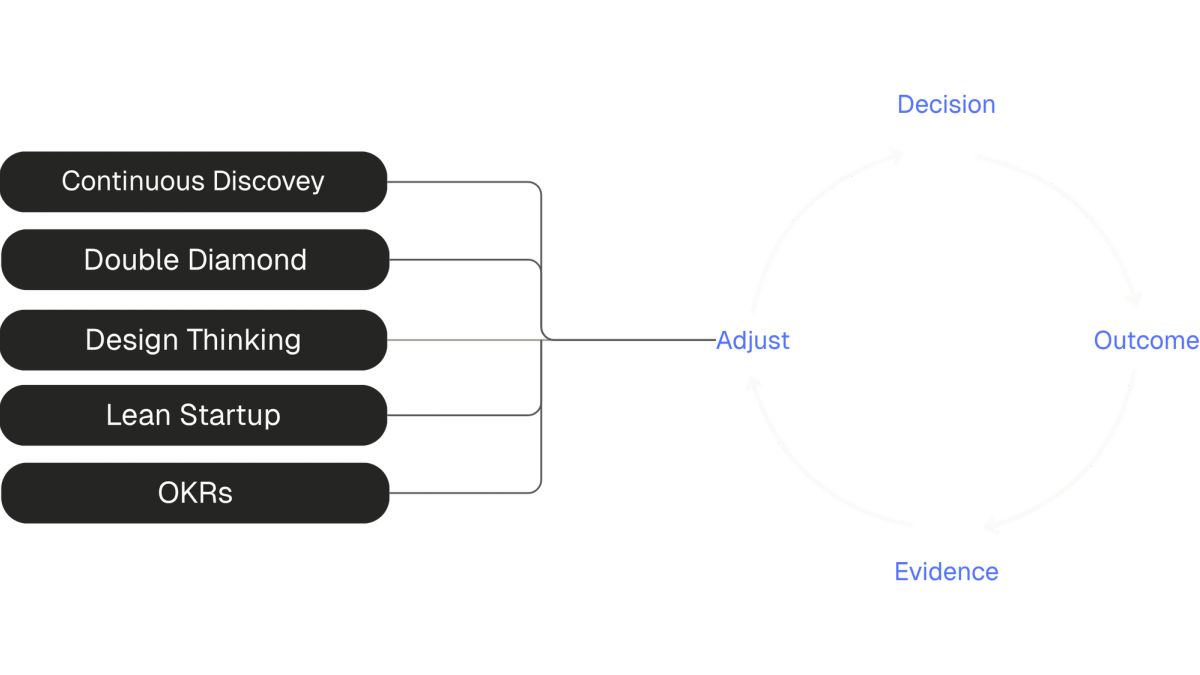
The Product Integrity System

Kill bad product bets early.
Deliver good ones faster.

Shorter Loop connects customer evidence, strategy, planning, delivery, and learning in one product system. Teams can stop weak bets before they absorb more work, move stronger bets into smaller releases, and keep learning after they ship.

Objective Opportunity A Automate exec reporting Opportunity C Email scheduler Not built · 4 days Slack digest bot Invalidated · 21 days In-app summary Not built · 5 days Exp-1 0/3 Exp-2 3/3 Exp-3 1/3 Delivery Metrics Feedback
7 days to kill two bets · 42 days to learn the third was wrong · both are logged
LiveProvenNever builtBuilt, then invalidated

PRODUCT THEATER

Free your team from product theater.

Roadmaps, reviews, status decks, and planning rituals are useful when they help a team decide or learn. They become product theater when maintaining the appearance of progress takes time away from understanding customers, making choices, delivering useful work, and learning what happened.

Shorter Loop reduces that drag by keeping the context attached to the work as it moves.

Product theater

Roadmaps maintained mainly to reassure stakeholders

Product work

Roadmaps used to choose, sequence, and revisit bets

Product theater

Large releases committed before the riskiest assumptions are tested

Product work

Smaller releases that create value and learning sooner

Product theater

Context rebuilt in meetings, decks, and handoffs

Product work

Reasoning stays attached to the work as it moves

Product theater

Shipping treated as the finish line

Product work

Outcomes feed the next decision

One connected system from customer evidence to delivered value

Feedback, discovery, strategy, roadmaps, delivery work, and outcomes stay connected, so the team does not have to rebuild the context at every step.

01. Discover
Turn scattered customer evidence into opportunities.

Bring support conversations, sales notes, interviews, and other feedback into the same product context. Shorter Loop clusters related signals into opportunities while keeping the original customer evidence attached, so the team can see what is recurring and why an opportunity deserves attention.

02. Strategize and plan
Turn the strongest opportunities into a strategy and smaller bets.

Connect objectives to opportunities and solutions, compare alternatives, and make the important assumptions visible. Test the assumptions that could make an expensive bet fail before committing the full investment.

03. Deliver and learn
Turn good bets into releases, then learn from what happens.

Break solutions into epics, features, and smaller releases while keeping them connected to the objective they are meant to move. After release, compare what happened with what the team expected and carry that learning into the next decision.

"The dashboard is too cluttered on mobile."
G2 Review • 2 days ago
"I spend 2 hours a week manually exporting this to PDF for my boss."
Intercom • Today
"Login page keeps timing out."
Support Ticket • #4492
⚡
Opportunity Detected
Automate Executive Reporting
Multiple users are manually exporting data for stakeholders. High friction workflow for the "Manager" persona.
12 Signals
High Urgency
Impact: Retention
OBJECTIVE (OBJ-1)
Increase Net Retention (NRR)
LIVE STRATEGY VIEW
Opportunities
OPP-1HIGH VALUE
Automate Weekly Digests
Solutions
SOL-1RICE: 920
Email Scheduler Engine
SOL-2
Slack Bot Integration
Experiments
EXP-1VALIDATED
Fake Door: "Schedule" Button
EXP-2
Customer Survey
Outcome Dashboard
CHURN RATE (MANAGERS)
2.1% ▼ 15%
WEEKLY ACTIVE USERS
8.4k ▲
Live Roadmap
Q3 Outcome: Fix Enterprise Retention
● SHIPPED   ● IN PROGRESS
Released
Oct 1 - Oct 15
Increase Net Retention
OBJ-1
Email Scheduler Engine
PDF Generator V2
In Progress
Oct 15 - Nov 1
Expansion Revenue
OBJ-2
Slack Bot Integration
Up Next
Nov 1+
Advanced Analytics
OBJ-3
AI Insights

Sage

Sage helps you investigate, decide, and move product work forward — and it pushes back when the reasoning does not hold.

Ask Sage what matters, what changed, what to do next, or how to turn a direction into a smaller release. It can synthesize evidence, compare options, draft product artifacts, and keep watching the assumptions behind the plan. When the evidence is weak, it says so and helps you work out what to learn next.

Forms a point of view

Compares evidence and alternatives, then makes a recommendation and shows the reasoning behind it.

Does the product legwork

Synthesizes feedback, frames opportunities, drafts product artifacts, and helps shape smaller releases.

Strong convictions, weakly held

Pushes back when the reasoning is weak and changes its view when new evidence changes the case.

Grounded and inspectable

Shows the sources behind important claims and marks uncertainty instead of hiding it.

Sagethinking…
YouReal-estate financial management is a hot field right now — should we invest in solutions for it?
  1. Planning next steps
  2. Searching your evidence"real estate financial management"found 1 item
  3. Searching your evidence"target segment · vertical market · investment"
  4. Loading product context
  5. Recording assumption"real-estate financial management is a viable adjacent market for this product"
  6. Ranking your open assumptions by expected value of informationfound 5 ahead of this one
  7. Composing your answer

Not yet — and the evidence argues for staying the course.

Across all 40 artifacts in your product — 9 opportunities, 3 solutions, 5 KPIs, 22 feedback items — there is zero evidence connecting you to real-estate financial management. No feedback, no interview signal, no research. “It’s a hot field” is a reason to look, not a reason to build.

Meanwhile you have five high-cost assumptions sitting unvalidated in the strategy you already have — each one closer to revenue, each one able to sink your core bet if it’s wrong. That’s where your discovery bandwidth should go.

I’ve logged the real-estate idea as an assumption to test rather than a plan to act on, and I can design the experiments to validate the five ahead of it whenever you want.

What the corpus actually contains

The two corpus searches returned only your existing strategy artifacts, focused entirely on autonomous expense capture and reconciliation, ERP-sync reliability, employee activation friction, and multi-entity enterprise expansion. Your product vision — rendering the financial close obsolete by capturing, coding, and reconciling every transaction at the moment of spend — is a horizontal finance-operations play, not a vertical real-estate play.

Why “it’s a hot field” is insufficient

Real-estate financial management is a distinct domain — lease accounting (ASC 842 / IFRS 16), property-level P&L, CAM reconciliation, tenant billing — none of which appear anywhere in your corpus. Entering it would require new domain expertise, new buyer personas (property managers, REITs, asset managers) with no overlap with your current mid-market finance persona, and new capability development competing for the same engineering resources as your already-unvalidated core bets.

ASSUMED · high cost: Real-estate financial management represents a viable adjacent market for this product, with pain points that overlap our current capabilities.
Assumption ID: 304df115fb15b5644c14e24a

Validate these instead — five high-EVPI assumptions already in your strategy

PriorityAssumptionEVPI
1Enterprise customers (>1,000 employees) experience timesheet management as a distinct pain point driving deal loss1.50
2Timesheet features meaningfully drive close-time reduction, comparable to ERP-sync improvements1.50
3The 42% activation gap is caused by timesheet friction, not receipt capture or approval workflow1.50
4Real-time spend analytics reduces month-end close time by ≥25% vs. reactive tools1.50
5Finance teams perceive timesheet management as belonging in the same surface as expense capture1.00

All five are untested at a 50/50 prior. If any of the top four are wrong, you face significant rework on your core strategy — which makes them a far better use of discovery bandwidth than an unrelated vertical.

Recommendation

ActionPriority
Validate the top 3 EVPI assumptions via customer interviews and deal post-mortemsDo now
A lightweight discovery spike (5–8 interviews with real-estate finance operators) — only with a specific capability-overlap hypothesisBacklog
Invest in real-estate financial management as a product directionNot without evidence
An actual Sage session, captured — not a scripted demo.

PRICING

One price per product. Everyone who works on it can join.

Product decisions cross functions. Support contributes evidence, product makes choices, engineering changes the shape of the work, and leadership needs to understand the bet. Shorter Loop charges per product, not per seat, so those people can work in the same system without adding another seat charge.

$500 per product / month

Billed annually. $600 when billed monthly.

Unlimited users. All product capabilities.

Invite product managers, engineers, designers, researchers, support, sales, and leadership without changing the price of that product.

Connect the systems where product context already lives

Integrations bring support conversations, research, customer data and delivery work into the same decision context. That makes it possible to see what evidence supports a claim and where relevant information is missing or stale.

BBrevo
HHubspot
SSalesforce
AApi
AAzure
GGithub
JJira
LLinear
RRally
WWebhook
AAha
CCanny
CCraftio
FFreshdesk
HHelpscout
IIntercom
PPendo
PProdpad
PProductboard
SServicenow

Rigor is how you go faster.

Time disappears when weak bets stay alive too long, releases grow before important assumptions are tested, and context has to be reconstructed every time work changes hands. Shorter Loop keeps the reasoning attached to the work so teams can stop weak bets earlier and move stronger ones with less rework.

The amount of evidence should match the size and reversibility of the bet. Small, reversible changes can ship and learn. Large, expensive bets deserve earlier testing of the assumptions that could sink them.

The cost of correcting a weak bet rises as more work is committed

Built for teams who refuse to do theater

Try Shorter Loop on a real product decision.

Bring the evidence you already have. Shorter Loop helps connect it to the objective, options, delivery work, and outcome so your team can decide what to do next without rebuilding the context.

✓ No credit card required✓ 14-day full access