The PM becomes a request clerk
Triage, tagging and replies fill the week. There is no time left to find the problem behind the requests.
Customer feedback management
Shorter Loop brings feedback from your support, sales and product tools into one list, groups it by the problem each item describes, and shows which customers are raising it. When a problem holds up, it becomes an opportunity with every feedback item still linked to it. The example below follows one team from 207 feedback items to the problem behind its churn.
This page uses an anonymized example from a real customer use case you can open and inspect.
The problem
Support tickets sit in Zendesk, sales notes in the CRM, votes on a portal, interview notes in a document somewhere. A product manager reads them one at a time. When planning comes round, the request with the most votes, the biggest account or the most senior sponsor goes in.
What usually counts as demand
Every source arrives with the same weight. None of them says which problem the customer actually has.
A harder look
Feedback tools now summarise, cluster and rank requests with AI. Give them a pile of wish lists and escalations and they will still return a clean pattern, because finding patterns is what they are built to do. Nothing in the output says whether the pattern is real.
A vote count measures who wrote in. A product decision needs three other things: the problem behind the requests, the customers who have it, and other evidence that agrees.
What the research says
Most customers never post, vote or comment. The few who do shape the picture, and companies tend to trust that picture more than their customers do.
What it costs the team
In our experience, the cost shows up in the product team's week long before it shows up in churn.
Triage, tagging and replies fill the week. There is no time left to find the problem behind the requests.
Sales escalations and executive ideas win, because nobody can show what the quieter customers need.
Customers describe one problem in different words, and each version is handled on its own.
The team built the fix a customer asked for. The problem behind it turned out to be a different one.
A better way
Keep listening everywhere. Change what happens after the feedback arrives.
01
Support, sales, product tools and your own customer board feed one list, each item tagged with its source.
02
Requests that describe the same problem sit together, whatever words the customer used.
03
See which segments the feedback comes from, and whether they are the customers you're building for.
04
A problem that holds up becomes an opportunity, with every feedback item still linked to it.
05
Interviews, analytics and documents back the opportunity or contradict it, before anyone writes a spec.
How Shorter Loop does it
Feedback in Shorter Loop sits next to the opportunities and delivery work it informs. Each item shows what it fed, and each opportunity shows the items behind it.
Connect Zendesk, Intercom, Freshdesk, Help Scout, HubSpot, Canny, Pendo, Slack and more, or upload CSV and JSON. Each item keeps a link back to the original.
Invite customers to vote, comment and post on your board, or embed the feedback widget in your product.
Open any item to see others that describe the same thing, each with a percentage match. Someone posting a near-duplicate is nudged to vote on the existing item.
Generate clusters from your feedback, or build them by hand. Summarize turns a cluster into a short summary and the problem it describes. You decide what gets published.
See which customer segments are most engaged, which need attention, and what each one raises most.
Turn an item or a cluster into an opportunity, epic, feature or story. The Feedback tab on each one lists the items behind it.
Customer story Solveo · one quarter of feedback
Solveo sells a customer-support platform with AI answers to 214 B2B customers. The board asked the product team why accounts were leaving. The answer was already in the feedback, spread across Zendesk and Intercom and filed under a dozen different requests. Every step below happened in Shorter Loop.
| Company | Customers | Feedback items | Sources |
| B2B customer-support platform | 214 | 207 | Zendesk, Intercom |
STEP 01
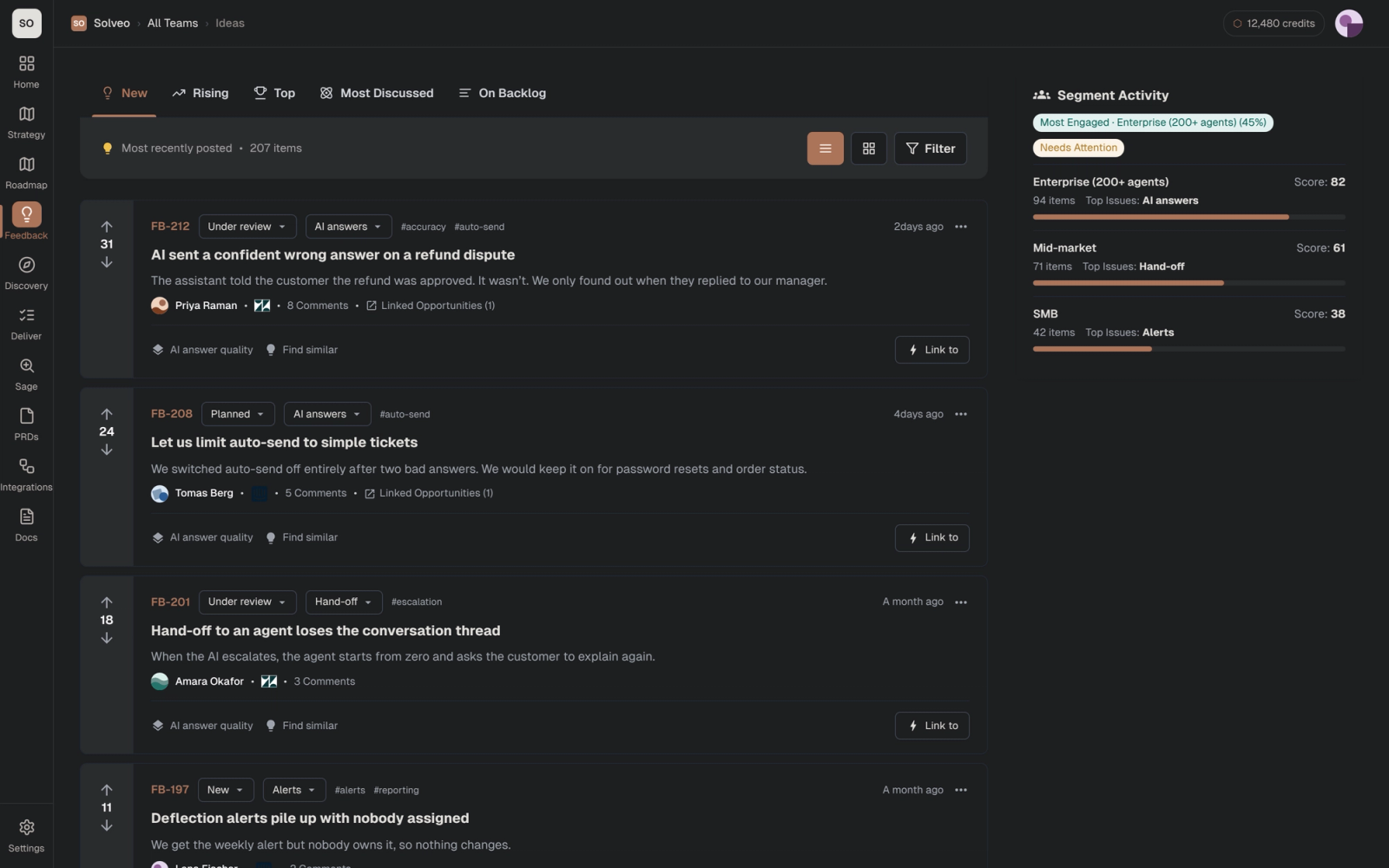
Support conversations from Zendesk and Intercom landed in one list: 207 items, each with its votes, status, category, tags and a link back to the original conversation.
The segment panel showed where the volume came from. Enterprise accounts with more than 200 agents produced 45% of the activity, and their top issue was AI answers.
STEP 02
FB-212 reported that the AI had told a customer their refund was approved when it wasn't. Find similar on that item returned fourteen others, each with a percentage match: an invented returns policy, a wrong delivery date, a callback promised that nobody could make.
Each came from a different account, in different words. Read one at a time, they looked like fourteen separate bugs.
STEP 03
Generate Clusters drafted the groups. The team reviewed them, moved a few items and published the result.
The largest cluster held 38 items. Most asked for a fix: limit auto-send to simple tickets, switch the AI off for some queues, show a confidence score. Read together, they described one problem. The AI was answering hard tickets with a confidence it hadn't earned.
STEP 04
Summarize turned the 38 items into a short summary and a problem statement: on medium and high complexity tickets, AI answers are confidently wrong, and customers stop trusting auto-send after one bad answer.
Sage also listed potential opportunities from the cluster. The team kept one and dropped the rest.
STEP 05
From the cluster, the team created OPP-4: AI answers are confidently wrong on medium and high complexity tickets. All 38 items stayed linked. The opportunity's Feedback tab lists them, and each item shows the opportunity it fed.
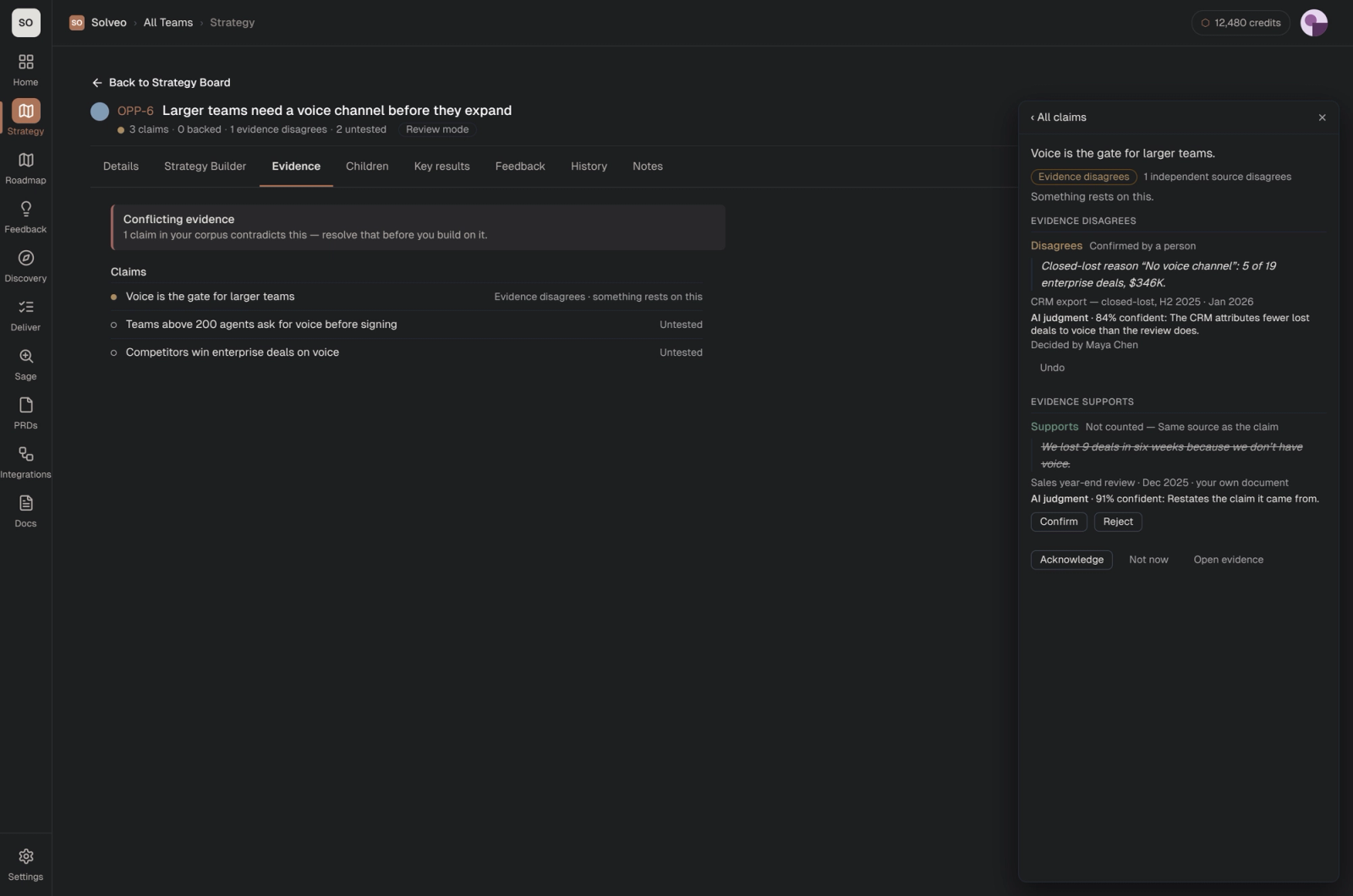
Sage then broke OPP-4 into claims and checked them against exit interviews and a support ticket analysis. Nine of the twelve claims were backed. What the team did with OPP-4 next is on the Strategize page.
Support tools such as Zendesk, Intercom, Freshdesk and Help Scout, your CRM, Slack, product tools such as Pendo and Canny, CSV or JSON uploads, and your own customer board and widget. Each item keeps its source and a link back to the original.
It matches items by meaning as well as wording and shows each match as a percentage. Nothing is merged automatically. You decide whether to link the items, add them to a cluster, or leave them as they are.
Most shouldn't. Feedback becomes an opportunity first, and the opportunity has to hold up against your objectives and other evidence before anything is built.
You can keep it. Shorter Loop imports from Canny, Productboard and others. It also has its own customer board and an embeddable widget if you'd like everything in one place.
The team does. Generated clusters, summaries and suggested opportunities are drafts. People review them, publish clusters, create opportunities and make the call.
The value comes from reading across sources. A dozen requests in three tools can describe one problem nobody has connected yet.
It depends on how fast you can connect what you already have. For a ten-person team that has typically taken about five days.
Connect your support and sales tools, group the requests by the problem behind them, and see which problems hold up before they reach the roadmap.
This page uses an anonymized customer example. You can open the demo to inspect the feedback, clusters and opportunity shown here.