01#1
Objectiive
What impact we want to achieve
Planning with Integrity
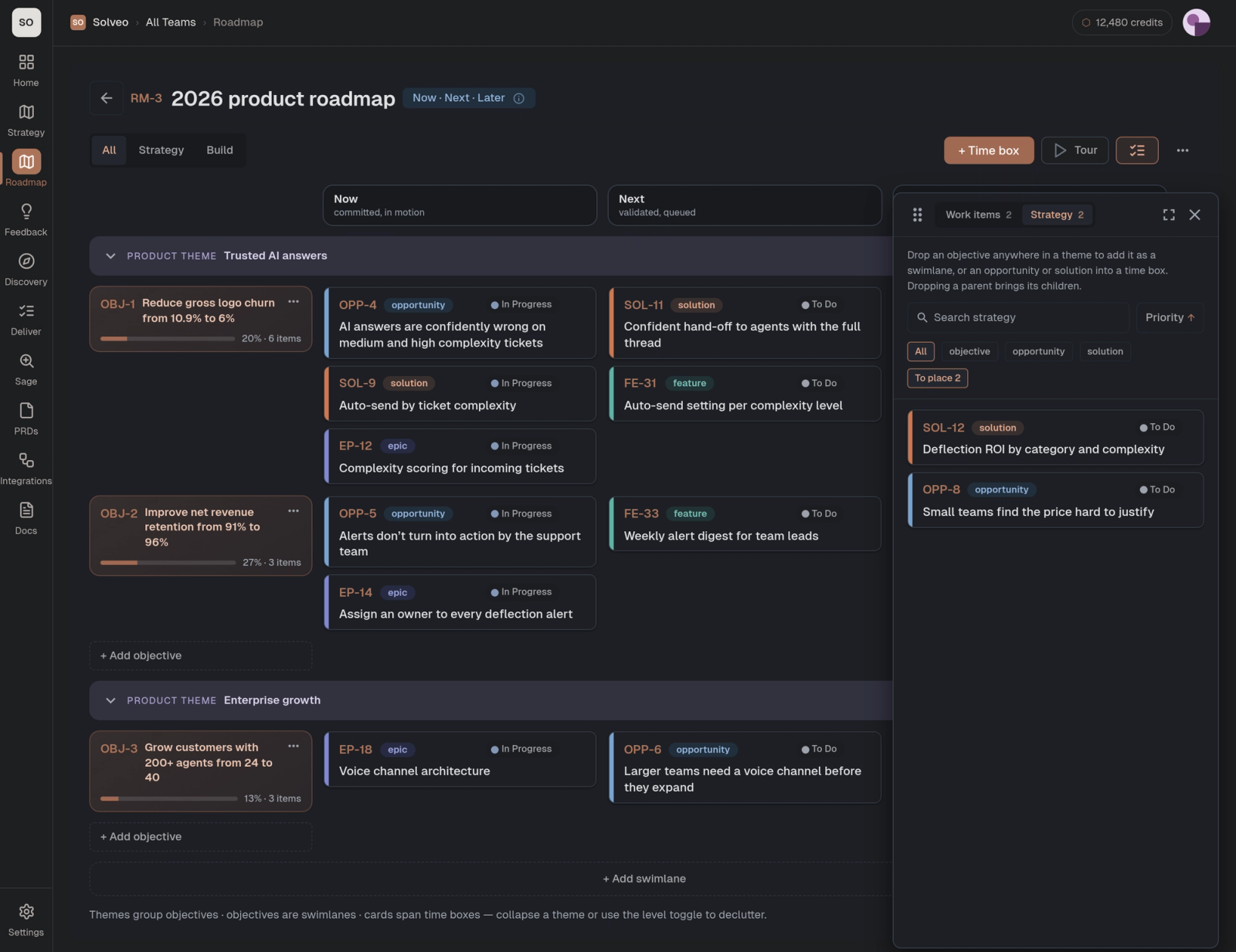
Put objectives, opportunities, solutions, epics and features on one roadmap. Each item stays linked to the objective it serves and the opportunity behind it, so anyone who asks why it's there can open it and see.
This page uses an anonymized customer example. The theme, objective and delivery links can be inspected in the demo.
A roadmap is more useful when every item can show which objective it supports and why that objective exists.
The Problem
A typical roadmap is a list of features placed in time. The objective each item serves, the customer evidence behind it, and the options the team turned down live in other places: a strategy deck, a discovery doc, an epic description in Jira, or the memory of whoever was in the room.
That works while the same people stay and nothing changes. A few months later, someone asks why an item is in Now, and the team rebuilds the answer from those places, if it can.
What a roadmap is for
Sales, leadership and customers read the roadmap to learn where the product is heading. They use it to plan their own work: which deals to pursue, what to tell a customer, where to put budget next quarter.
Most roadmap reviews check scope and dates, because that's what the roadmap shows. The reasons behind each item rarely get checked, so nobody notices when they go stale. An item can sit in Next long after its customer problem was solved another way, or after the objective it served was dropped.
When the roadmap explains its reasons, the people reviewing it can ask a more useful question: is each bet still worth making, given what we know now?
For sales-led teams, the roadmap also needs to keep customer commitments connected to the product decisions behind them.
| What roadmap reviews check | What they should also check |
|---|---|
| Is the scope right? | Does the objective still matter? |
| Will it ship on the date? | Is the customer problem still open? |
| Who owns it? | Would we still pick this solution today? |
What product teams report
The survey doesn't connect these two findings. In our experience, they are connected. When the reasons for a roadmap item are spread across four tools, they aren't in the room when a senior leader asks to change the order. The PM can say the item matters but can't show why on the spot.
The discussion moves from evidence to seniority, and the item with the strongest customer case can lose to the one with the most senior sponsor.
People pay for that. Engineers switch work mid-quarter. A customer who was told a fix was coming hears that it slipped. The PM who ran the interviews behind the item watches them lose to a request nobody had to justify.
What it costs the team
The cost rarely shows up as one big failure. It shows up in the week before every review, and in decisions nobody can explain a year later.
The spreadsheet roadmap
15.6% of product teams build and maintain their roadmap in a spreadsheet, and another 12.3% in presentation tools (ProductPlan, 2026). Spreadsheets are fast, free and flexible, which is why teams start there. The trouble starts a few months in, because a cell holds what someone typed on the day they typed it.
Effective Roadmaps
A useful roadmap shows the chain behind each item: the objective you want to move, the opportunity you're pursuing, the solution you chose, and the epics and features that deliver it.
01#1
What impact we want to achieve
02#2
The customer problem or need
03#3
How we plan to address it
04#4
What we will build
The plan will still change. Discovery turns up new problems, and some bets lose. When someone proposes a change, everyone can see what the current item was meant to achieve and weigh the two on the same terms.
The Shorter Loop way
The items on a Shorter Loop roadmap are the same objectives, opportunities, solutions, epics and features your team uses in strategy, discovery and delivery. The roadmap places them in time. Nothing is retyped.
One limit. The roadmap can only show reasons the team has recorded. An epic added with no objective or opportunity above it sits on the roadmap with nothing to explain it, until a PM links it.
A PM adds objectives, opportunities, solutions, epics and features to the same roadmap and groups them by theme and time.
Build a Now / Next / Later roadmap or a Timeline roadmap. A product can have more than one roadmap.
The PM opens the backlog drawer and drags existing items onto the roadmap.
The PM moves cards between lanes or time periods. On a Timeline roadmap, when the PM changes an item's span, Shorter Loop updates its dates.
Anyone with access opens a card to see the opportunity, solution, epic or feature behind it, and the objective it serves.
Copy a link for people who already have access, or export the roadmap as PDF or Excel.
Steps 01–02
Solveo has a 40-person product organisation with a retention team, a platform team and 400 customers.
A theme represents an organisation-level investment direction such as reducing churn, improving customer experience or entering a new market. It can carry a share of investment without prescribing the work each team must do.
Product teams then define objectives that explain how they intend to contribute to the relevant theme. Solveo's retention team chose an early-churn objective while the platform team chose an objective related to setup time.
Both objectives could reasonably support the churn theme. Putting them on the same connected roadmap made the relationship between the two plans visible.
Keeping themes and objectives in connected data makes it possible to inspect how team plans actually support company priorities.
Step 03 · January 2026
The retention and platform teams were building different features, but both plans depended on the same explanation for churn.
Solveo believed onboarding was too difficult. Because each objective could carry the assumption behind it, both teams' Q1 2026 plans showed the same underlying claim: onboarding difficulty was causing churn.
The duplication was therefore visible at the level that mattered. Two teams were funding six weeks of engineering against the same unverified claim, even though they planned to build different features.
Import wizard v2
Four weeks, two features. Assumes the blocker is effort.
Guided setup flow
Two weeks, one feature. Assumes the blocker is effort.
Steps 04–05
Board, leadership, product and engineering views can show different levels while remaining connected to the same underlying items.
Because each item knows its parent, the roadmap can show themes to a board, objectives to leadership, epics to product teams and features to engineers without creating separate planning artefacts.
The level of detail changes for the audience, but updates continue to come from one connected structure. That reduces the drift that occurs when slides, spreadsheets and delivery systems each contain a separate version of the plan.
Step 06 · February 2026
A roadmap needs to represent work that was intentionally stopped as well as work that is planned, underway or shipped.
Evidence showed that the churning accounts had already completed onboarding. Because both teams' planned work was connected to the same assumption, Solveo could see in February which epics should be stopped before more engineering time was committed.
The roadmap distinguishes planned work, work in progress, work stopped with a reason, and shipped work that is still being assessed. That preserves changes in direction instead of making each quarterly roadmap look as though the earlier plan never existed.
A roadmap should make it easy to change a plan when the evidence changes, while preserving the reason for that change.
Investment share
The share of investment can remain sensible even when the team's explanation for a specific problem changes.
Solveo continued to allocate most of its investment to reducing churn throughout the year because the business priority remained valid.
The research changed who the company understood as an important user. Dispatchers did not appear in the plan in January; by February, the depot experience had a persona and a clearer case for future investment.
August 2026
By August 2026, the same timeline showed what had been planned, what had stopped and why, what had shipped, and which outcomes were still being assessed. The churn objective remained open at 15% against a 12% target, so the review did not require a separate reconstruction of the quarter.
Themes are organisation-level investment directions and are usually set by leadership. Product teams then define objectives that explain how they intend to contribute to the themes relevant to them. This keeps strategic direction separate from prescribing team-level solutions.
The time intervals are configurable. You can use quarters, releases, sprints or broader horizons. The important structure is the connection from themes to objectives and then to delivery work.
Yes. The same roadmap can show themes and investment to a board, objectives to leadership, epics to product teams and features to engineers. Each view reads from the same connected structure.
Dates can become promises when the roadmap only distinguishes planned from done. Shorter Loop can also show work that was stopped with a reason and shipped work that is still being assessed, which makes changes in direction explicit.
Because objectives carry the assumption they rest on, two teams betting on one belief appear under the same theme with the same badge. In the anonymized customer example, the duplicate is two teams funding one unsourced claim while building different features.
Probably not yet. Use objectives on a timeline and add themes when you have more teams than you can hold in your head, usually around the third one.
Use the same underlying plan at different levels of detail, and keep the assumptions and evidence behind each objective available when priorities change.
This page uses an anonymized customer example. You can inspect the theme-to-feature relationships and roadmap states in the demo.